Saturday, December 10, 2011

End of the Semester Summary

              As I sit here thinking about what to write for my final reflection, the first thing that comes to mind is that this semester has certainly flown by.  Over the course of the semester I have learned so much about literacy.  The multigenre project allowed me to become a literacy specialist by allowing me to apply the strategies and tools that I have learned throughout my two years in the graduate Literacy program.  However, I can honestly say that one of the most important things I learned was how to become a word learner and make word learning fun and applicable through the use of a vocabulary blog. 

               Through the authoring of a vocab blog I have benefited greatly as both an educator and as a student.  I truly believe that the blog made my learning interesting and encouraged me to take an in-depth word at words. Throughout the course of the semester, I would search for words to add to my blog.  The blog fostered a deeper love and understanding of word learning.  Through the use of the vocabulary blog I benefited as a word learner.  I became enthusiastic and excited to learn new words.  I was excited to post my findings on my blog.  Posting on my blog provided me with a way to share my word knowledge with my peers. 
           
              I can honestly say that this blog was very beneficial.  The public aspect of the blog, forced me to dig deeper because I wanted to make sure that the definitions and analysis of each word that I provided were truly accurate.  I did not want to steer my classmates in the wrong direction.  As an educator, I can see the benefits of incorporating vocabulary blogs into the classroom.  Learning vocabulary would become interesting and engaging because of the technology aspects of the assignment.   Also, the accountability that one feels when authoring a blog, requires students to take the assignment seriously.  I personally loved the blog and would definitely incorporate a vocabulary blog in my future classroom. 

When I look back over my blog entries, it looks like I am attracted to “uncommon” words; words that are not usually brought up in conversation.   Many of the words that I posted on the blog were words that I was unfamiliar with.  In order to find these words, I would turn to the course texts or online.  I became a detective, searching for words that would solve the puzzle to my understanding of course texts or daily conversations.  I thoroughly enjoyed dictionary.com’s word of the day page.  This website provided me with many of the words that I posted on my blog.  Other words that posted on the blog were from some of the course texts, professional words that would be important for me to know as a literacy specialist.  I think that the majority of the words that I posted were mostly “uncommon” or “unusual” words were because I knew that I had to find words for my blog. 
         
              The blog also forced me to search for words that I would want to post.  I turned to the internet and also course texts.  I began reading-to-learn.  I read to find words that I did not know so that I could look them up and post them on the blog.  Posting on my blog then became my way of writing-to-learn.  Writing allowed the words to “stick.”  Through the blog and all the reading and writing I was doing, I became more knowledgeable about words.  I became cognizant of my word learning and my vocabulary has expanded through the use of the blog. 

Word learning also continued through the weekly viewing of my classmates’ blogs.  Not only did I have to maintain my own blog, I also had to make it a habit to post and view others’ blogs.  I enjoyed looking to see what words my classmates would post.  The vocabulary tests helped to ensure that my classmates and I viewed one another blogs.  At first, I was not thrilled with the idea of vocabulary tests.  As an English teacher and literacy specialist, I have a deep love of words.  However, my love of words did not transpire into a love of vocabulary tests.  Even as an adult and educator, I did not see the benefits in testing students on words.  I knew first hand that these students would just study the words for the purpose of the text, and then forget them in a few days when the test was done.  The VSS tests allowed my classmates and I to choose words that were important and meaningful.  Two times over the course of semester, my classmates and I would nominate words from our own blogs for a vocabulary test.  Dr. Jones would post the nominated word list on Moodle, and then we had to look on each other’s blogs to find the definitions of the words that we would be tested on.   I liked this set-up and I think my future students would also enjoy it.   
                What happens now?  Will my “word searches” continue? Before keeping this blog, I looked up unfamiliar words, so I am sure that I will continue that habit even with the blog posted coming to a close.  However, creating a blog has given me a better understanding and knowledge of the process of word learning.  It has also provided me with an example of a way to make word learning interesting and fun for my future students.   Before the blog, word study was looking up unfamiliar words that I found while reading and writing the definition in the margins of the text.   However, once the books that I wrote in closed, I never looked back at the words that I “learned.”  The blog forced me to continue using the words that I learned.  I wasn’t merely providing a definition.  I had to think about why the word was important.  I loved this.  As a result of the blog, I believe that word searches became more interesting.  I also believe that I will be more aware of the word learning process.  The blog encouraged me to become a better word learner through the use of technology.  Who knows maybe I will post a word every now and then to this blog.  Be on the lookout!  

Monday, November 28, 2011

13.1 Panegyric

When and Where did I find the word: I went online to dictionary.com's word of the day page and found "panegyrize" was the word of the day.  The definitions that were provided confused me even more.  For example, "To indulge in panegyric; bestow praises."  Since I had no idea what panegyric meant, this definition did not help me.  As a result, I decide to look up the word panegyric. 

What is means: According to dictionary.com, panegyric is "a lofy oration or writing in praise of a person or thing; eulogy."  It is also a "formal or elaborate praise." 

Level of Familiarity: I have never heard this word before. 

Do I Want to Know This Word Well and Why? I have never heard this word before and for that reason I looked it up. I feel like this word is a "high-class" word, meaning that it is used in very formal situations and therefore, I feel that many people do not know this word.  Including myself.  However, because I like words, I am glad I learned this word.
Do I Think Others Should Know This Word Well...if so WHO and WHY?: I don't think this is a word used in daily conversation. I don't think that this word is imperative to know, however, I do believe that if one comes across this word, then one should look it up.  I think that building vocabulary is important for everyone and therefore if the word is stumbled upon, one SHOULD look it up. 

Sunday, November 20, 2011

12.2 Mitigate

When and Where did I find the word: I found this word on dictionary.com's word of the day page.  I have not visited the page in a while due to the high amounts of new words that I have finding in my assigned readings, so I figured it was time to pay a visit to the site.   

What is means: According to dictionary.com, mitigate means "to lessen in force or intensity, as wrath, grief, harshness, or pain; moderate; to make less severe: to mitigate a punishment; to make (a person, one's state of mind, disposition, etc.) milder or more gentle; mollify; appease; to become milder; lessen in severity."  


Level of Familiarity: I have heard and used this word several times before. 

Do I Want to Know This Word Well and Why? Mitigate is a good word to know.  I have word heard the word mitigate several times in daily conversations and even on television. The word mitigate seems to be a "popular" word that is used by many and in many different circustances.

Do I Think Others Should Know This Word Well...if so WHO and WHY?: As I said before, I have heard this word several times before and as I result I consider it a word to know.  I figure that if it is used a lot, it is a word worth knowing.   I think that everyone should know this word.
.

12.1 Apropos

When and Where did I find the word: I found this word in one of our course texts (Content-area writing).  The word can be found on page 162. 

Citation:
Daniels, H., Zemelman, S. & Steineke, N. (2007.  Content-area writing.  Portsmouth, NH: Heinemann.

What is means: The sentence states that "one focus that might be especially apropos, if many students have chosen conversations . . ." (p. 162).  I had to read this sentence several times but I still could not find many contexts clues to help me figure it out.  I tried breaking the word down into word parts, hoping that maybe it would help me to define the word.  I found the word "appropriate" in the word, and the word "pro." Based on these findings I knew that word have to be something positive.  However, I still turned to my trusty friend, dictionary.com, to help me define the word.  According to the website, apropos means "fitting; at the right time; to the purpose; opportunely."

Level of Familiarity: I was not familiar with the word apropos until this very moment (well probably a few days have gone by since this was posted). 


Do I Want to Know This Word Well and Why? I did want to know this word and that is why I looked it up.  Without knowledge of this word and I would not have been able to complete or fully understand the assigned chapter reading for the week. 

Do I Think Others Should Know This Word Well...if so WHO and WHY?: I think others that are reading the course text should know this word.  Without knowledge of this word, they will not have a complete understanding of what the author is trying to say in that one particular sentence.  I also think anyone that encounters this word should know this word. 

Sunday, November 13, 2011

11.2 Studying

When and Where did I find the word: I  also found this word in Jessica and Danielle's assigned article for the week.  The word is located on p. 278. 

Citation: Davis, S. J. (1990). Applying content study skills in co-listed reading classrooms.   Journal of Adolescent & Adult Literacy, 33(4), 277-281.        


What is means: The author uses "Anderson and Armbruster's (1984) definition of studying as a special form of reading that is done in order to perform an identifiable cognitive task."  The author then goes on to say that "they difivde studying into two components: state and processing variables. State variables are those relating to the student and the material. Processing variables are those used in focusing attention and in encoding and retrieving information" (p.279). 
Level of Familiarity: Like most graduate students and educators,  I am VERY familiar with the word studying. 


Do I Want to Know This Word Well and Why? I do want to know this word.  I hate studying but I think by better understanding how to study, I will like the word better.  I think that when students hear the word they often shut down.  Maybe studying is given such a bad rep, is because it isn't being done correctly, or teachers aren't explicity teaching study skills. 


Do I Think Others Should Know This Word Well...if so WHO and WHY?: I think everyone should know what studying is, the "science" of it, not just the process.  I think educators, especially, and even students should know how to study and what studying is.  I think so many students don't truly know what studying is or how to do it.  I think by having educators be educated on what is so that they can educate their students on studying, is very imperative. 

11.1 Idiosyncratic

When and Where did I find the word: I found this word in the article that Danielle and Jessica assigned us for the week.  The word can be found on page 280 where the authors state that "studying is an idisyncratic process" (Davis, 1990).

Citation: Davis, S. J.  (1990).  Applying content study skills in co-listed reading classrooms.  Journal of
                             Adolescent & Adult Literacy, 33(4), 277-281                      


What is means: The authors do not provide a definition or much of an elaboration of the word idiosyncratic for readers.  According to dictionary.com, idiosyncratic means "pertaining to the nature of idiosyncrasy, or something peculiar to an individual."  I had to do a little more research on this word and look up the work idiosyncrasy in order to gain a better understanding of the word.  Dictionary.com defines idiosyncrasy as "a characteristic, habit, mannerism, or the like, that is peculiar to an individual."  Therefore, studying is a peculiar process. 

Level of Familiarity: I am somewhat familiar with this word.  I have heard it once or twice but never really in the educational process. 

Do I Want to Know This Word Well and Why? I did want to know this word.  Studying plays a major role in education and I wanted to know why the author was calling studying an "idisosyncratic process."  I felt that in order to truly understand what the author was saying I had to look up the word. 

Do I Think Others Should Know This Word Well...if so WHO and WHY?: I think that everyone should have a general understanding of this word to use in conversation.   I feel that educators should know this word, especially since it was used in conjunction with studying.  Personally, I feel that if you run across a word you do not know, LOOK IT UP. I love learning new words and then using them.

Monday, November 7, 2011

10.2 Morphology

When and Where did I find the word: I found this word in the article that Carrie and Meghan assigned to the class this week. The word can be found on page 137 of the article. 

Citation: Kieffer, M. J.  & Lesaux, N. K.  (2007).  Breaking down words to build meaning:
                            Morphology, vocabulary, and reading comprehension in the urban classroom.
                            The Reading Teacher, 6(12), 134-144. 


What is means: The authors state that "the word morphology can be broken down (morphologically) into two meaningful parts (known as morphemes): morph- meaning shape and ology-meaning the study of.  Thus, morphology, in its most generic form is the study of shape.  In language and reading morphology refers to the study of the structure of the words, particularly the smallest units of meaning in words: morphemes" (p. 137). 

Level of Familiarity: I am familiar with this word.  I have heard this word a lot during my graduate work. 

Do I Want to Know This Word Well and Why?  As a literacy specialist and as an educator I think that it is imperative that I know this word, not only for myself but for my students. Like the authors of the text say, knowing how to break down words and look at prefixes or suffixes is important when it comes to building vocabulary which ultimately helps to aid in comprehension of the text.  Students need to be aware of morphology and how to break down words into smaller root parts. 

Do I Think Others Should Know This Word Well...if so WHO and WHY?: I think that everyone should have a knowledge of this word.  Morphology is important for students in their vocabulary development.  The authors state that "effective word-learners attack unknown words, break them into their meaningful parts, hypothesize meanings against the context of the text as well as their own background knowledge" (p. 135).   As educators we need to stress the importance of morphology to our students.  Students need to be able to break down words in order to succeed. 


10.1 Wide Reading

When and Where did I find the word: I found this word in one of our course texts (Word Wise and Content Rich).  The word is found in Chapter 4 on page 132. 

Citation:  Fisher, D. & Frey, N. (2008).  Word wise and content rich: Five essential steps to
                              teaching academic vocabulary.  Portsmouth, NH: Heinemann. 

What is means: The authors of the text state that "in the United States, wide reading refers to the in- and out-of-school practices of learners who engage with a variety of genres. In-school approaches to wide reading include sustained silent reading, which allows for student choice in what is read, and independent reading, where students are given blocks of uninterrupted time to read content-aligned material" (p. 132).  Wide reading programs give students opportunities to become better readers and allows them to experience a multitude of different genres. 

Level of Familiarity: I have never heard of the term wide reading before, but I have heard of sustained silent reading.  In my elementary and my early middle school years,  DEAR (Drop Everything And Read) was constantly implemented, however, it stopped once I moved on to the higher grades. 

Do I Want to Know This Word Well and Why? I do want to know this word well.  Wide reading programs help to improve reading.  As a Literacy Specialist,  I should know this word well and be knowledgeable about the different types of reading programs that are considered wide reading.  After reading about wide reading,  I definitely see its benefits, especially in the higher grades. 

Do I Think Others Should Know This Word Well...if so WHO and WHY?: Definitely! I think all educators, especially Literacy Specialists, should know this word.  Educators should have a basic knowledge of how to implement a wide reading program into their classroom and even into their schools! Wide reading helps students to develop better reading habits and helps to improve students vocabulary.  When I googled this word, there were a lot of different websites to help teachers, administrators, and even community members, initiate a wide reading program. 

Saturday, October 22, 2011

8.2 Importunate

When and Where did I find the word: You all should be very proud of me, I switched up my online dictionary resource, and instead of resorting to dictionary.com's word of the day, I moved to Merriam-Webster's word of the day!!! (A little variety is a good thing). 

What is means: According to Merriam-Wesbter online, importunate means "troublesomely urgent: overly persistant in request or demand."  The sentence provided states "Sylvia was becoming fed up with the importunate phone calls she continued to receive from charities seeking donations." 


Level of Familiarity: I have heard this word before, but like many other words, I needed to be reminded of the words exact meaning. 


Do I Want to Know This Word Well and Why? I kind of like this word.  I think it is a good word to use in conversation.  I mean, look at how the word is used in the sentence above.  I love it and it makes Sylvia seem very irrated, and the calls even more obnoxious.  I think I am in love with this word!! Just kidding about that but I think this word is another one of my million dollar words (or is it one hundred).


Do I Think Others Should Know This Word Well...if so WHO and WHY?: Of course! Personally, I think this is a good word to use.  Think of all the things or people in your life that you could use this word for.  It is a good word to describe. 

8.1 Voluble

When and Where did I find the word: I found this word in one of our course texts (Content-Area Writing).  The word is located on p. 78.  The sentence states "However, if you are a student who writes (or thinks slowly, and you're sitting between a bunch of voluble, fluent writers, it can make you feel like a doofus."

Full Citation: Daniels, H., Zemelman, S. & Steineke, N.  (2007).  Content-area writing.  Portsmouth, NH: Heinemann. 

What is means: The sentence gives some hint to readers as to what the word means.  However,  I wanted  a clearer definition.  As always, I resorted to dictionary.com.  According to the website, voluble means "talking easily, readily, and at length; fluent." 
 
Level of Familiarity: I hope I am not the only one in my class that has not heard this word before?!  I do not remember ever hearing this  word.  I have heard and used the word fluent to describe someone that can easily read, or write, or do things almost perfect. 


Do I Want to Know This Word Well and Why?  I do want to know this word.  I think it would be a good word to use in my own vocabulary to "spice" it up.  Instead of using fluent, I can use the word voluble.  Or like the authors of the text in which I found the word,  I can use the word voluble to avoid repetition in a sentence. 

Do I Think Others Should Know This Word Well...if so WHO and WHY?: YES! I believe voluble is a valuable word to use! How was that for a tongue twister??? I think it should be incorporated into one's vocabulary.  It is a good word to use when describing someone that is fluent with writing.  As literacy specialist,  I want students to be voluble readers and writers. 

Saturday, October 15, 2011

7.3 Audacity

When and Where did I find the word: I have heard this word before but I was ecstatic today when one of my cheerleaders used the word!

What is means: According to dictionary.com, audacity means "boldness or daring, especially with confident or arrogant disregard for personal safety, conventional thought, or other restrictions." For example, as my cheerleader said, "She had the audacity to yell at me."

Level of Familiarity: I am very familiar with this word and have used it several times in my own conversations (maybe the cheerleader heard the word from me and maybe she will influence the other girls to use it??)
Do I Want to Know This Word Well and Why? I know this word and it is definitely a good word to use.  As my cheerleaders said to the one that used the word, "You sound smart." It is one of those "million dollar words." 


Do I Think Others Should Know This Word Well...if so WHO and WHY?: I think everyone should KNOW this word and USE this word.  Like I said before, the word is a good word to use in conversation and sounds so much better than saying, "I can't believe she did that." 

7.2 Regurgitate

When and Where did I find the word: I found this word on the Merriam-Webster's online dictionary website. 

What is means: According to the website, the word regurgitate means "to throw or be thrown back, up, or out." For example, the website offers this sentence to help users understand better: "Instead of sharing some new ideas, the book regurgitates the same old arguments that other authors have tried before."

Level of Familiarity: I am familiar with this word and have heard it several times.  However, when I read the sentence it made me think of the word in a different way.  As an educator, do I regurgitate lessons or information??  Is my content delivered in the same way every lesson?

Do I Want to Know This Word Well and Why? I know this word. However, I want to know it in a different way, or become more aware of it as an educator.  As a student I remember sitting in classes and having the teachers deliver the same form of instruction class after class. It became repetitive and boring.  Often times, these teachers taught the same lessons to each of their classes, and did not differentiate instruction or change it up.  As educators I think we should be aware of this form of regurgitation. 

Do I Think Others Should Know This Word Well...if so WHO and WHY?: I think everyone should know this word, especially educators.  Students should know the word to expand their vocabulary. As educators, do we regurgitate the same lessons or materials that were once regurgitated to us? Do we regurgitate the same form of instruction to each and every class or lesson we teach? It is good to become aware of regurgitation as an educator. 

7.1 Self-Regulated Strategy Developement

When and Where did I find the word: I found this word in the Mason, Benedek-Wood and Valesa (2009) that Janet and I are presenting in class on Monday. I hope you have all read it ;)

What is means: Guess what?! I did not have to resort to dictionary.com this week.  In the article the authors quote Harris, Graham, and Mason (2003) as saying that "Self-Regulated Development (SRSD) instruction is one approach for teaching writing that focuses on explicity teaching strategies for planning, regulating, and self-monitoring written instruction." They go on to say that "SRSD instruction is designed to promote independent use of task-specific writing strategies by teaching students cognitive and self-regulation strategies so they can better understand and regulate the writing process."

Level of Familiarity: I have heard about SRSD instruction in undergrad, however, it was used for reading.  This is my first time reading about gearing SRSD instruction to writing. 


Do I Want to Know This Word Well and Why? I do want to know this word.  As an educator, SRSD instruction is important.  Self-regulated strategy use is important for students and as educators it is the ultimate goal.

Do I Think Others Should Know This Word Well...if so WHO and WHY?: YES! As educators we should know this word.  SRSD instruction is important for all content areas.  As educators SRSD is the ultimate goal for any strategy that we introduce to students.  We want students to be able to self-regulate and independently use any strategy that we introduce to them.  SRSD instruction is not just for writing, but also reading. 

Monday, October 10, 2011

6.2 Titubant

When and Where did I find the word: I found this word on dictionary.com's word of the day section. Throughout the week I was searching for that "it" word but could not find it so I resorted to the internet.  Once, I found titubant, I knew it was the "it" word I had been looking for. 

What is means: Like all my other words, I had to resort to dictionary.com to figure out what this unfamiliar word meant (thank goodness I didn't have to do much searching. The defintion was already provided on the word of the day page).  According to dictionary.com titubant means "a disturbance of body equilibrium in standing or walking, resulting in an uncertain gait and trembling." 

Level of Familiarity: Zero, null. I have no familiarity with this word and I can honestly say that I have never encountered it before. 

Do I Want to Know This Word Well and Why? Like I have said in previous posts I think all words are worth exploring and knowing.  However, would I use this word again? Probably not. 

Do I Think Others Should Know This Word Well...if so WHO and WHY?: I think others should find out what this word means if they are to encounter it but as far as just knowing it to know it, I don't see much use for it.  Personally, I think it is a difficult word and I could see many of my students not fully understanding it, even with a definition provided to them.  I also don't see or hear it being used much in the English language that I encounter, so I feel that students would learn it and then forget it because they wouldn't hear or use it again. 

Sunday, October 9, 2011

6.1 Valiant


When and Where did I find the word: I found this word on none other than Facebook (I should have been doing so many other things).  While Facebook stalking, one of my friends on Facebook posted a picture and the caption said, "she gave it a effort." 

What is means: According to dictionary.com valiant means, "boldly courageous; brave; stout-hearted." It also means "marked by or showing bravery or valor; heroic; worthy;excellent." 


Level of Familiarity: This is a word that I have encountered several times in many different situations.  However, it is not a word I normally use in my own conversations.  This word is another "heart" word for me.  I love the way it sounds.  It sounds almost "royal," "regal" or "high-class." 

Do I Want to Know This Word Well and Why? I think this word is a good word to know.  As I said before it sounds "regal" and I personally think when it is used it makes a person sound smart.  Valiant is a good word to describe one'seffort (as my Facebook friend did).  I think as teachers, instead of saying excellent job, we could say "valiant effort." What do you think???

Do I Think Others Should Know This Word Well...if so WHO and WHY?:  Of course I think others should know this word.  Like I said before, I have encountered this word several times.  I think this word is a great descriptor.  I think my future students should definitely know if because they might see it as a comment on one of the projects they will submit.

Sunday, October 2, 2011

5.2 Attitudinal

When and Where did I find the word: I found this word in one of the required readings (Dreher & Singer, 1989).  The authors state: "Attitudinal and confidence qualifications are more common in expository texts that are not usually used as textbooks in schools."

Full Citation: Dreher, M. J. & Singer, H.  (1989).  Friendly text and text-friendly teachers.  Theory Into Practice, 28(2), 98-105. 

What is means: I really like this word, so it is more of a "heart" word for me.  When I hear this word, I picture a little girl with a pout on her face and hands on her hips.  As my dad would say she has "attitudie."  According to dictionary.com attiudinal means "manner, disposition, feeling, position, etc., with regard to a person or thing; tendency or orientation, especially of the mind." 


Level of Familiarity: Before looking up the definition, I had a general understanding of the word.  I knew the word and I had heard the word, but my knowledge of the definition was basic. 

Do I Want to Know This Word Well and Why? As I said before, I knew the word at a basic level.  To mean, when I heard attitudinal, I just thought of attitude. I didn't think of the word as a whole.  The word doesn't just include the physical appearance that one may have based on their attitude.  The physical appearance may and can be the end result.  What makes the physical appearance is one's manner, disposition, feelings, or position on an issue. 

Do I Think Others Should Know This Word Well...if so WHO and WHY?:  Everyone should know this word.  I have heard this word in so many conversations and have read it in so many different articles and texts.  Attitude plays a major role in our lives, having another word to describe attitude or its impact on an issue is important. 

5.1 Concomitant

When and Where did I find the word: I found this word in our course text (Kamil, Mosenthal, Pearson & Barr, 2000) Chapter 19 on page 286. The authors state: "Finally we reflect on the diversification of society and the concomitant changes that this brings to text-based learning."

Full Citation: Kamil, M. L., Mosenthal, P. B., Pearson, P. D., & Barr, R. (Eds.).  (2000). Handbook of reading research:  Volume III.  Mahwah, NJ:
                        
                         Lawrence Erlbaum Associates.

What is means: Wow! What a heavy duty sentence, and I think what makes it so difficult for me is the word "concomitant."  I honestly had to read it over a couple of times until I finally got a general idea of what it meant.  However, I was still stuck.  According to dictionary.com concomitant means "existing or occurring with something else, often in a lesser way; accompanying; concurrent." It is also defined as "a concomitant quality, circumstance, or thing."  Based on this definition, I now understand the sentence.  I am always amazed at the power of a word and how one word can completely throw of one's understanding of a sentence or text. 

Level of Familiarity: Before looking up the definition, I had zero knowledge of the word. 


Do I Want to Know This Word Well and Why? I wanted and needed to know the word concomitant.  Without knowledge of this word, I would have been stuck and unable to read on if I did not understand the sentence. 


Do I Think Others Should Know This Word Well...if so WHO and WHY?:  I think that anyone who is reading the Handbook should have knowledge of this word.  Like, I said before, if I didn't know the word I would have been stuck and unable to read on.  The word is a good word to know, especially if one is reading the Handbook.  I think it is a word that one would see a lot in research. 

Monday, September 26, 2011

4.3 Lexicon

When and Where did I find the word: I found this word in our course text (Billmeyer & Barton, 1998)  on page 19. The authors state: "Each content area has its own unique vocabulary or lexicon."


Full Citation: Billmeyer, R. & Barton, M.L. (1998).  Teaching reading in the content areas: If not me, then who?  (2nd ed.).                        
                          Aurora, CO: Mid-continent Regional Educational Laboratory.              
                         
What is means: I have come across this word several times and I find it extrememly important for all educators to know.    As the authors state, a lexicon is a specific vocabulary for a specific content area or profession.  To get a more "in-depth" definition I turned to dictionary.com.  According to dictionary.com lexicon "the vocabulary of a particular language, field, social class, person, etc."


Level of Familiarity: During my undergraduate work I heard the word lexicon a lot.   In fact the text ( Billmeyer & Barton, 1998) was used in one of my undergraduate courses.  However, I haven't heard the word much during my grad work until now.  As Literacy Specialists (or soon to be literacy specialists) we have our own lexicon. 


Do I Want to Know This Word Well and Why? I already know this word but I think realizing the importance of this word is important. As educators in different content areas, or as literacy specialists, we have our own lexicon.  We may know the "language" but we as educators can NOT expect our students to just know what we know. 

Do I Think Others Should Know This Word Well...if so WHO and WHY?: I think that the word lexicon is important to know, but like I have said, it is important to know that lexicons exist in education throughout the many different content areas.   As educators we need to educate our students on the lexicon in our content area.   

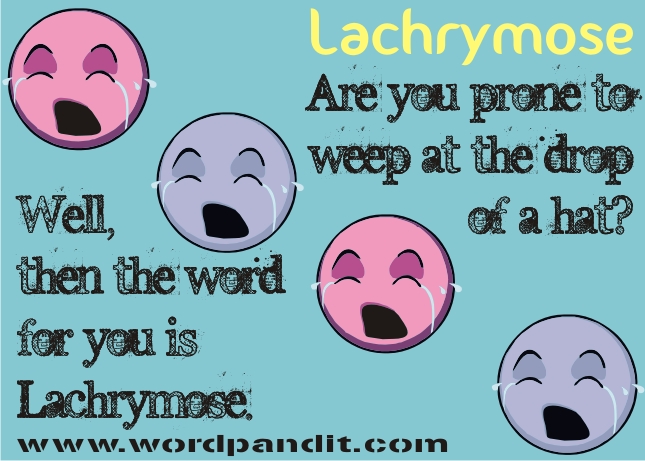
4.2 Lachrymose

When and Where did I find the word: Before spending the entire Sunday on the couch due to Tonsilitis, I spent my entire Thursday night trying to clean my room preparing for my upcoming move.  While cleaning I ran across an SAT Vocabulary list from High School.  It seemed like fate, especially since I had to find words for this vocabulary blog.  One of the words on the list, struck my eye: lachrymose. 

Website: http://www.majortests.com/sat/wordlist-01

What is means: The nice thing about the SAT Vocabulary list is that it defines the word for you.  That way, I didn't have to feel like to much of an idiot for not knowing a word that high school students should know according to this website.   According to the website, lachrymose means "tearful or sad." 

Level of Familiarity: I must have glanced at this word once in high school if I had a copy of the wordlist.  However, when I ran across the word a second time, I was still stumped.  It is not a word that I hear many people using in conversation. 

Do I Want to Know This Word Well and Why? Yes, I want to know this word.  If this word is included on the SAT word list, then I need to know it in order to prepare my future students for the SAT.  Plus, if the SAT is saying that high school students should know it, then THIS adult should also know it. 


Do I Think Others Should Know This Word Well...if so WHO and WHY?: As a said before, I have never  heard this word come up in conversation, however, the SAT board is saying that students should know this word.  Therefore, I think all educators should know this word and use this word in classes.  Students learn best when they want to learn the word, so maybe if we as educators use it, students will become curious to know what it means. 

4.1 Felicitous

When and Where did I find the word: I found this word in our course text (Daniels, Zemelman & Steineke, 2007) Chapter 5 on page 114.  The authors state: "It is the author's responsibility to make sure that spelling, punctuation, grammar, usage, and presentation are not just correct but exemplary, even felicitous."

Full Citation: Daniels, H., Zemelman, S. & Steineke, N. (2007).  Content-area writing.  Portsmouth, NH: Heinemann


What is means: I honestly do not remember ever coming in contact with this word.  The sentence above didn't really help me to define the word, so I of course had to turn to an outside source.  According to dictionary.com felicitous means that one is "well-suited for the occasion, as an action, manner, or expression; appropriate." It is also defined as "having a special ability for suitable manner or expression, as a person." Based on this definition, when the authors use the word felicitous in the above sentence, they are meaning that the text that a writer produces should be appropriate, and suitable for the intended audience or occasion. 

Level of Familiarity: Like I said before, I honestly do not remember ever coming across this word before.  Once I saw it in this weeks assigned reading, I had to know what it meant.


Do I Want to Know This Word Well and Why? Yes, I want to know this word.  When I came across this word I was immediately stumped.  I tried to figure it out using context clues around the word but nothing came to mind.  Once I was able to define it, I wanted to use it. 


Do I Think Others Should Know This Word Well...if so WHO and WHY?: I think that my future students, my fellow peers in LTED 625, and whoever else is reading this blog should know this word if they don't already.  Felicitous is a fun word to say and "well-suited" to use in many different conversations.