When and Where did I find the word: I found this word in our course text (Billmeyer & Barton, 1998) on page 19. The authors state: "Each content area has its own unique vocabulary or lexicon."
Full Citation: Billmeyer, R. & Barton, M.L. (1998). Teaching reading in the content areas: If not me, then who? (2nd ed.).
Aurora, CO: Mid-continent Regional Educational Laboratory.
What is means: I have come across this word several times and I find it extrememly important for all educators to know. As the authors state, a lexicon is a specific vocabulary for a specific content area or profession. To get a more "in-depth" definition I turned to dictionary.com. According to dictionary.com lexicon "the vocabulary of a particular language, field, social class, person, etc."
Level of Familiarity: During my undergraduate work I heard the word lexicon a lot. In fact the text ( Billmeyer & Barton, 1998) was used in one of my undergraduate courses. However, I haven't heard the word much during my grad work until now. As Literacy Specialists (or soon to be literacy specialists) we have our own lexicon.
Do I Want to Know This Word Well and Why? I already know this word but I think realizing the importance of this word is important. As educators in different content areas, or as literacy specialists, we have our own lexicon. We may know the "language" but we as educators can NOT expect our students to just know what we know.
Do I Think Others Should Know This Word Well...if so WHO and WHY?: I think that the word lexicon is important to know, but like I have said, it is important to know that lexicons exist in education throughout the many different content areas. As educators we need to educate our students on the lexicon in our content area.

Monday, September 26, 2011

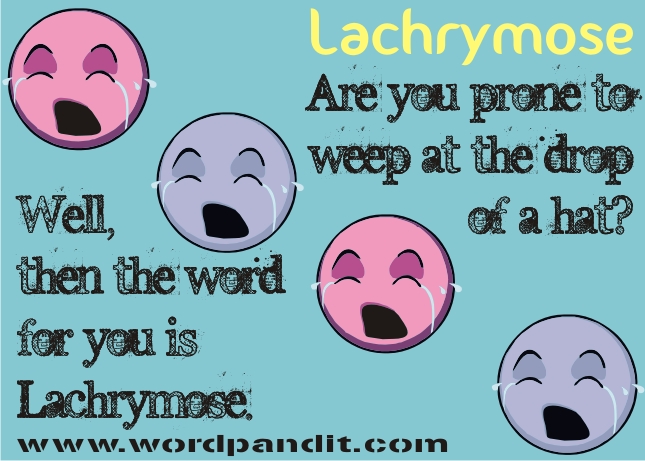
4.2 Lachrymose
Website: http://www.majortests.com/sat/wordlist-01
What is means: The nice thing about the SAT Vocabulary list is that it defines the word for you. That way, I didn't have to feel like to much of an idiot for not knowing a word that high school students should know according to this website. According to the website, lachrymose means "tearful or sad."
Level of Familiarity: I must have glanced at this word once in high school if I had a copy of the wordlist. However, when I ran across the word a second time, I was still stumped. It is not a word that I hear many people using in conversation.
Do I Want to Know This Word Well and Why? Yes, I want to know this word. If this word is included on the SAT word list, then I need to know it in order to prepare my future students for the SAT. Plus, if the SAT is saying that high school students should know it, then THIS adult should also know it.
Do I Think Others Should Know This Word Well...if so WHO and WHY?: As a said before, I have never heard this word come up in conversation, however, the SAT board is saying that students should know this word. Therefore, I think all educators should know this word and use this word in classes. Students learn best when they want to learn the word, so maybe if we as educators use it, students will become curious to know what it means.
4.1 Felicitous
When and Where did I find the word: I found this word in our course text (Daniels, Zemelman & Steineke, 2007) Chapter 5 on page 114. The authors state: "It is the author's responsibility to make sure that spelling, punctuation, grammar, usage, and presentation are not just correct but exemplary, even felicitous."
Full Citation: Daniels, H., Zemelman, S. & Steineke, N. (2007). Content-area writing. Portsmouth, NH: Heinemann
What is means: I honestly do not remember ever coming in contact with this word. The sentence above didn't really help me to define the word, so I of course had to turn to an outside source. According to dictionary.com felicitous means that one is "well-suited for the occasion, as an action, manner, or expression; appropriate." It is also defined as "having a special ability for suitable manner or expression, as a person." Based on this definition, when the authors use the word felicitous in the above sentence, they are meaning that the text that a writer produces should be appropriate, and suitable for the intended audience or occasion.
Level of Familiarity: Like I said before, I honestly do not remember ever coming across this word before. Once I saw it in this weeks assigned reading, I had to know what it meant.
Do I Want to Know This Word Well and Why? Yes, I want to know this word. When I came across this word I was immediately stumped. I tried to figure it out using context clues around the word but nothing came to mind. Once I was able to define it, I wanted to use it.
Do I Think Others Should Know This Word Well...if so WHO and WHY?: I think that my future students, my fellow peers in LTED 625, and whoever else is reading this blog should know this word if they don't already. Felicitous is a fun word to say and "well-suited" to use in many different conversations.
Full Citation: Daniels, H., Zemelman, S. & Steineke, N. (2007). Content-area writing. Portsmouth, NH: Heinemann
What is means: I honestly do not remember ever coming in contact with this word. The sentence above didn't really help me to define the word, so I of course had to turn to an outside source. According to dictionary.com felicitous means that one is "well-suited for the occasion, as an action, manner, or expression; appropriate." It is also defined as "having a special ability for suitable manner or expression, as a person." Based on this definition, when the authors use the word felicitous in the above sentence, they are meaning that the text that a writer produces should be appropriate, and suitable for the intended audience or occasion.
Level of Familiarity: Like I said before, I honestly do not remember ever coming across this word before. Once I saw it in this weeks assigned reading, I had to know what it meant.
Do I Want to Know This Word Well and Why? Yes, I want to know this word. When I came across this word I was immediately stumped. I tried to figure it out using context clues around the word but nothing came to mind. Once I was able to define it, I wanted to use it.
Do I Think Others Should Know This Word Well...if so WHO and WHY?: I think that my future students, my fellow peers in LTED 625, and whoever else is reading this blog should know this word if they don't already. Felicitous is a fun word to say and "well-suited" to use in many different conversations.
Monday, September 19, 2011
3.1 Magnanimous
When and Where did I find the word: I found this word while reading the journal article, "Extraordinary," "tremendous," "exhilarating," "magnificent": Middle school at-risk students become avid word learners with the Vocabulary Self-Collection Strategy (VSS) (2002) by Ruddell and Shearer. The authors provide their readers with Table that shows some of the VSS words that were collected for the purpose of their study. I have to admit that some of the words that the students provided were even difficult for me. The definitions were not provided for the words, which caused me to look up many of the words.
Full Citation: Ruddell, M.R. & Shearer, B.A. (2002). "Extraordinary," "tremendous," "exhilarating," "magnificent": Middle School at-risk students become avid word learners with the Vocabulary Self-Collection Strategy (VSS). Journal of Adolescent & Adult Literacy, 45(5), 352-363.
What is means: According to dictionary.com magnanimous is defined as being "generous in forgiving an iunsult or injury." It is also described as being "free from petty resentfulness or vindictiveness." One that is described as magnanimous could be described as being "high-minded" or "noble."
Level of Familiarity: I was not familiar with this word when I encountered it in the journal article. Up until now I had no idea what magnanimous meant.
Do I Want to Know This Word Well and Why? Yes, I want to know this word. As an English teacher, I love words and coming across a word I do not know, makes me stop and run to find the nearest dictionary. I do not like to just ignore a word I do not know. I like to figure it out.
Do I Think Others Should Know This Word Well...if so WHO and WHY?: I think that my future students and my fellow peers in LTED 625 should definitely learn this word. I feel that if the word was included in the journal's word list that was comprised of words that students chose, that this word must be common in everday life. Students must be hearing it in their daily lives and if they are hearing it, they should know what the word means.
Full Citation: Ruddell, M.R. & Shearer, B.A. (2002). "Extraordinary," "tremendous," "exhilarating," "magnificent": Middle School at-risk students become avid word learners with the Vocabulary Self-Collection Strategy (VSS). Journal of Adolescent & Adult Literacy, 45(5), 352-363.
What is means: According to dictionary.com magnanimous is defined as being "generous in forgiving an iunsult or injury." It is also described as being "free from petty resentfulness or vindictiveness." One that is described as magnanimous could be described as being "high-minded" or "noble."
Level of Familiarity: I was not familiar with this word when I encountered it in the journal article. Up until now I had no idea what magnanimous meant.
Do I Want to Know This Word Well and Why? Yes, I want to know this word. As an English teacher, I love words and coming across a word I do not know, makes me stop and run to find the nearest dictionary. I do not like to just ignore a word I do not know. I like to figure it out.
Do I Think Others Should Know This Word Well...if so WHO and WHY?: I think that my future students and my fellow peers in LTED 625 should definitely learn this word. I feel that if the word was included in the journal's word list that was comprised of words that students chose, that this word must be common in everday life. Students must be hearing it in their daily lives and if they are hearing it, they should know what the word means.
Subscribe to:
Posts (Atom)